Starting is absolutely the hardest part.
Not finishing.
Not even doing the hard work.
Starting.
I was reminded of that recently when I had a 90-minute window unexpectedly open up in my calendar. A client rescheduled at the last minute. On my desk? A list six proposals long—client presentations, strategy plans, documents that required real thinking and real creativity.
And what did I do?
I reached for my phone.
It was almost automatic. Scroll. Check messages. Peek at email. Anything but begin.
And then that phrase that’s been living in my head lately—“I do it anyway”—hit me square in the face.
Girl, you just need to start.
One of the proposals felt particularly daunting. It required deep writing. Creative thinking. Strategic framing. And here’s the irony: I love doing that kind of work. It’s one of the reasons I love what I do. But creativity requires engagement. It requires mental activation. And if I’m not already “in the mood,” it can feel like pushing a car uphill.
So I paused and asked myself:
What’s actually getting in the way of starting?
The answer wasn’t capability. It wasn’t time. It wasn’t skill.
It was resistance.
And resistance often disguises itself as distraction.
The Resistance to the Very Things That Help Us
Exercise is another example for me.
I know I’m going to work out every day. It’s not optional. It’s a decision I made and committed to 90+ days ago. And yet, I hate it. Still. Sometimes I delay the start. I’ll reorganize something. Check one more email. Refill my water.
All while knowing that if I just begin, I’ll be done in 30 minutes—and I’ll feel amazing.
Isn’t it wild?
Even the things that energize us, grow us, strengthen us… we can resist starting them.
This is why accountability buddies work.
This is why people lay their running shoes by the door.
This is why some schedule workouts first thing in the morning before the brain can negotiate.
Because the hardest part is not the workout.
It’s the first rep.
The first step.
The first five seconds.
It’s the same concept behind Mel Robbins and her Five Second Rule. Count down. Move. Act before your brain talks you out of it.
The action creates momentum. Not the other way around.
The Path of Least Resistance
Years ago, I sat next to a friend of mine at a board meeting. He was an executive coach—but also a wilderness guide. He would take CEOs into the mountains and teach leadership through survival skills and nature immersion.
He leaned over and said, “Marge, look around. Nature always chooses the path of least resistance.”
He was right.
Water flows to the lowest point.
Plants grow toward the light.
Roots spread where the soil is softest.
We are products of nature.
So of course we default to what’s easiest. Of course our brain prefers the scroll over the start. Of course we’d rather delay discomfort than initiate effort.
But here’s the extraordinary part about being human:
We are not slaves to instinct.
We have the ability to override the path of least resistance.
We can choose the harder right over the easier wrong.
But it takes practice.
It takes habit.
It takes conscious interruption of that automatic drift toward comfort.
Where Resistance Is Gone—and Where It Remains
There are areas of my life where resistance no longer lives.
I don’t resist Sunday planning anymore. That used to be a thing. Sitting down, mapping out the week, making sure the kids are where they need to be, aligning meetings, prepping for coaching calls.
Now? It’s automatic. It’s a system. It’s a ritual.
Cooking dinner.
Preparing my schedule.
Following up with clients.
No friction.
Why?
Because I practiced through the resistance long enough for it to become identity.
But exercise? Still requires activation.
Creative proposal writing? Still requires ignition.
And I know people for whom exercise is the highlight of their day. They joyfully run five or six miles and look forward to it.
We’re all wired differently.
Resistance shows up in different places for different people.
The question isn’t whether you have resistance.
The question is:
Where is it showing up for you?
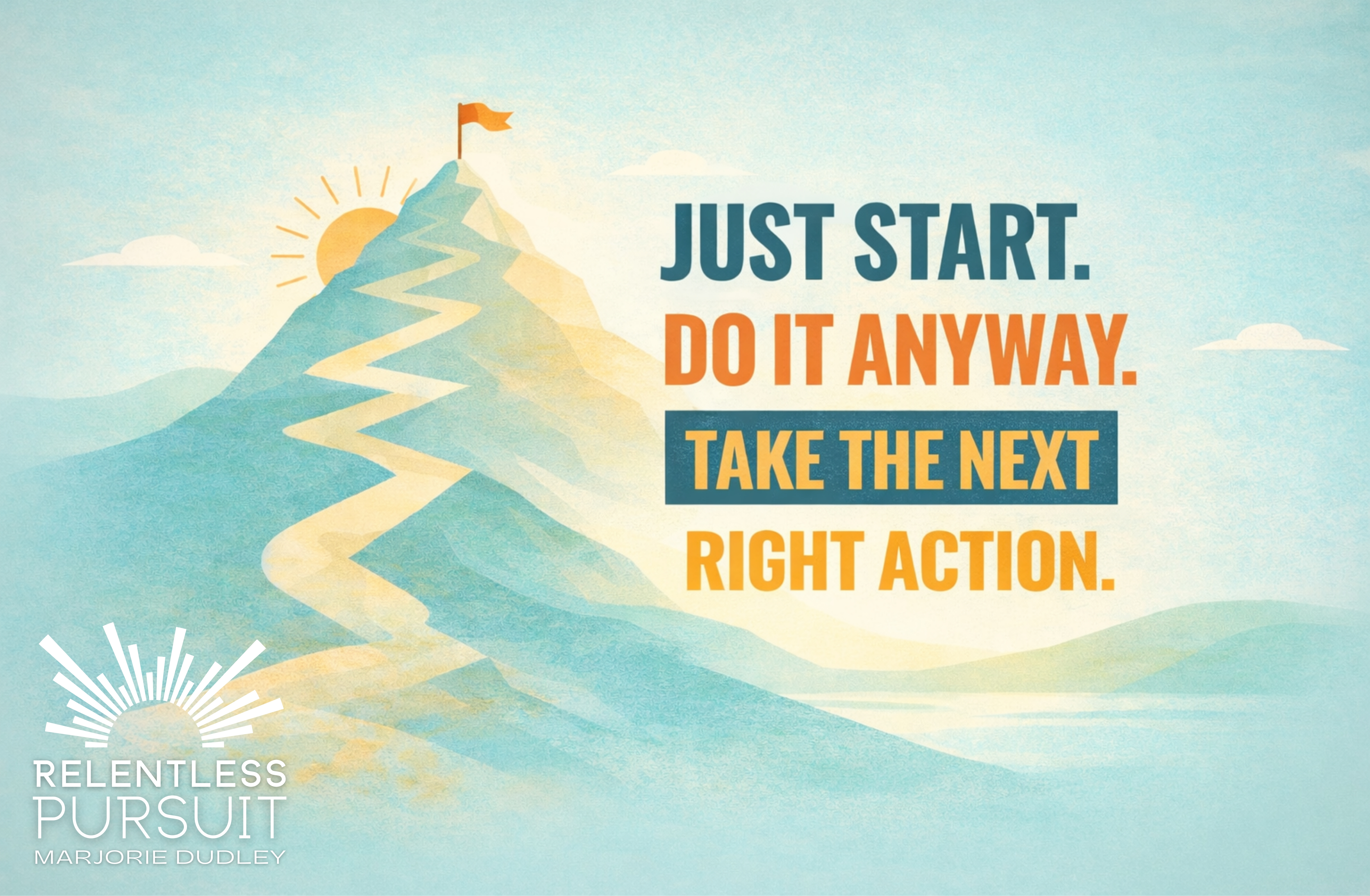
Just Start. Take the Next Right Action.
When I finally opened that proposal document, I didn’t commit to finishing it.
I committed to opening it.
Then to writing one section header.
Then to filling in three bullet points.
That’s it.
The next right action.
That phrase has been echoing in my head lately:
Just start.
I do it anyway.
Take the next right action.
Not the perfect action.
Not the complete action.
Not the polished action.
The next one.
Because starting breaks inertia.
And inertia is what keeps dreams theoretical.
Why This Matters More Than We Think
So many people believe they’re stuck because they lack clarity, confidence, or capability.
Often, they’re simply stuck at the starting line.
The business doesn’t grow because the proposal doesn’t get written.
The health doesn’t improve because the workout doesn’t begin.
The relationship doesn’t deepen because the conversation doesn’t start.
Momentum is built on initiation.
And initiation requires overriding the path of least resistance.
The more we practice that override, the more natural it becomes.
We train ourselves to act before we feel like it.
We train ourselves to move before motivation arrives.
We train ourselves to build before confidence confirms.
So Here’s What I’m Pondering—and Maybe You Should Too
Where is resistance showing up in your life right now?
- Is it the call you need to make?
- The proposal you need to write?
- The gym session you keep delaying?
- The strategy you’ve been thinking about but haven’t implemented?
What is the next right action?
Not the whole plan.
Not the 12-step system.
Just the first step.
And what would happen if you committed to “I do it anyway”?
Because here’s what I know:
Everything we want to create—stronger health, deeper relationships, thriving businesses, disciplined minds—lives on the other side of starting.
And starting is a skill.
A muscle.
A practice.
One we get better at every time we override the path of least resistance and choose action instead.
So open the document.
Lace up the shoes.
Make the call.
Start.
Stay Relentless.

Leave a comment