
Oftentimes I hear leaders acknowledge that leadership isn’t “one size fits all” in one breath while in another they say things like “well, I didn’t need that, and I was a top performer” or “they are adults, they should be able to hold themselves accountable / figure it out themselves / make their own way, like I did.” And I get it, we see what worked–and what didn’t work–for us and easily slide into the mindset that a particular style of leadership is what works. But that isn’t really the case, is it? I mean, if it were, everyone on our team would be having the same level of success, and they’re not, are they?
Not only are their different Navigate (DISC Communication) styles, but there’s different personalities, different degrees of emotional intelligence, different human needs; and there’s even different levels of Skillsets and Willsets.
Logically, we know to “meet people where they are” but are we doing it? If we look at our leadership style for every person on our team, can we honestly say we’ve adapted it for their needs? Have we even taken inventory on what their needs actually are?
The first step is to recognize that our leadership needs to shapeshift to the needs of the person we have been charged with leading. Not just to the whole team, but to the unique, specific person. I’ll give an example that will likely be a “duh!” moment, but hopefully you will see the parallel:
Is walking your child to their classroom while holding their hand inherently good, or inherently bad?
The obvious answer is “neither, and it depends.” It completely depends if you have a kindergartener on their first day or a college student already demonstrating effective independence. The activity isn’t good or bad, it’s value is characterized by whether or not it’s deployed at a developmentally appropriate time.
Similarly, our team requires developmentally appropriate styles of leadership. Yet, so often we’re just delivering the same leadership style–maybe the one that’s like what we would have wanted–regardless of the needs of the individual. We’re either making scared kindergarteners walk to the classroom alone or were hand-holding seasoned college kids who no longer need that helicopter.
“But the challenge, Marge…” I know that’s what you are thinking because it is the biggest challenge–is how do we sort who is in which group without a mythical, talking hat?

Allow me to introduce you to the Skill/Will Matrix. It’s a tool to quickly help you asses where each of your team members reside on the professional developmental curve and then lead them accordingly.
First, quickly write out 3-10 things that would make someone successful in a particular role based on skills. These can be things like:
✨ Proficient at Lead Gen
✨ Able to consistently set meetings
✨ Asks for and receives referrals
Then write out 3-10 things that would demonstrate that someone has the will or desire to be successful in their role, such as:
✨ Humble, implements feedback
✨ Shows a desire to continuously learn & improve
✨ Takes initiative, a problem solver
Now for each line item, give your team member a score; then find the average in the category. Next, rank them dichotomously as either High or Low in each category. Then determine if your team member is High Skill/High Will; High Skill/Low Will; Low Skill/High Will; or Low Skill/Low Will.
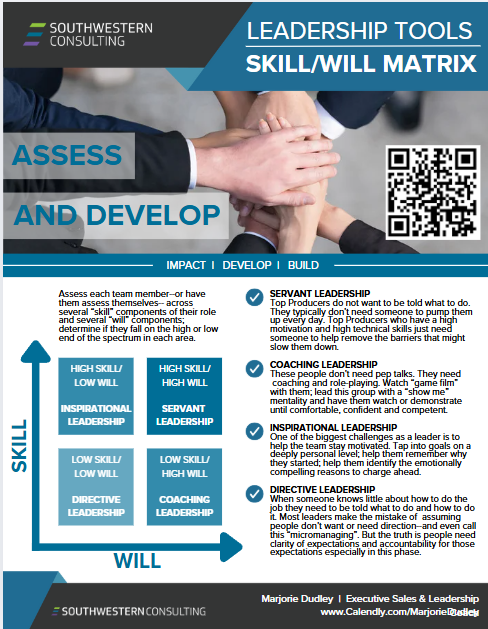
Depending on where they land, adjust your style, respectively from Servant Leadership, Inspirational Leadership; Coaching Leadership; or Directive Leadership. (See descriptions below in the image which you can also be sent as a pdf download upon request).
Servant Leadership (High Skill/High Will): Top Producers do not want to be told what to do. They typically don’t need someone to pump them up every day. Top Producers who have a high motivation and high technical skills just need someone to help remove the barriers that might slow them down. Your job is to block and tackle.
Inspirational Leadership (High Skill/Low Will): One of the biggest challenges as a leader is to help the team stay motivated. Tap into goals on a deeply personal level; help them remember why they started; help them identify the emotionally compelling reasons to charge ahead. Your job is to help them find their “why”.
Coaching Leadership (Low Skill/High Will): These people don’t need pep talks. They need coaching and role-playing. Watch “game film” with them; lead this group with a “show me” mentality and have them watch or demonstrate until comfortable, confident and competent. Your job is to help them skill-build effectively.
Directive Leadership (Low Skill/Low Will): When someone knows little about how to do the job they need to be told what to do and how to do it. Most leaders make the mistake of assuming people don’t want or need direction–and even call this “micromanaging”. But the truth is people need clarity of expectations and accountability for those expectations especially in this phase. Your job is to give them a clear, direct path to success.
Let the style depend not on what you would have wanted/needed, but what they need to be most effective. Of course, this should go without saying that all styles should be packed with empathy, curiosity, support, and encouragement. The takeaway, hopefully, is that different team member needs require us to adapt our leadership style to best serve them. Utilizing the Skill/Will Matrix is one tool that can help us quickly assess and adapt for the best possible results.
✏️ Bonus Tip: Creating a Skill/Will Matrix before hiring someone can be helpful with bringing clarity to your job description and interview process. It can also be utilized as a self-assessment taken by team members for quarterly/annual reviews.
📔 Skill/Will Cheat Sheet PDF: A free gift for YOU!📔Send me an email if you would like the Skill/Will Cheat Sheet PDF as shown below to help you shapeshift your leadership for any team member.
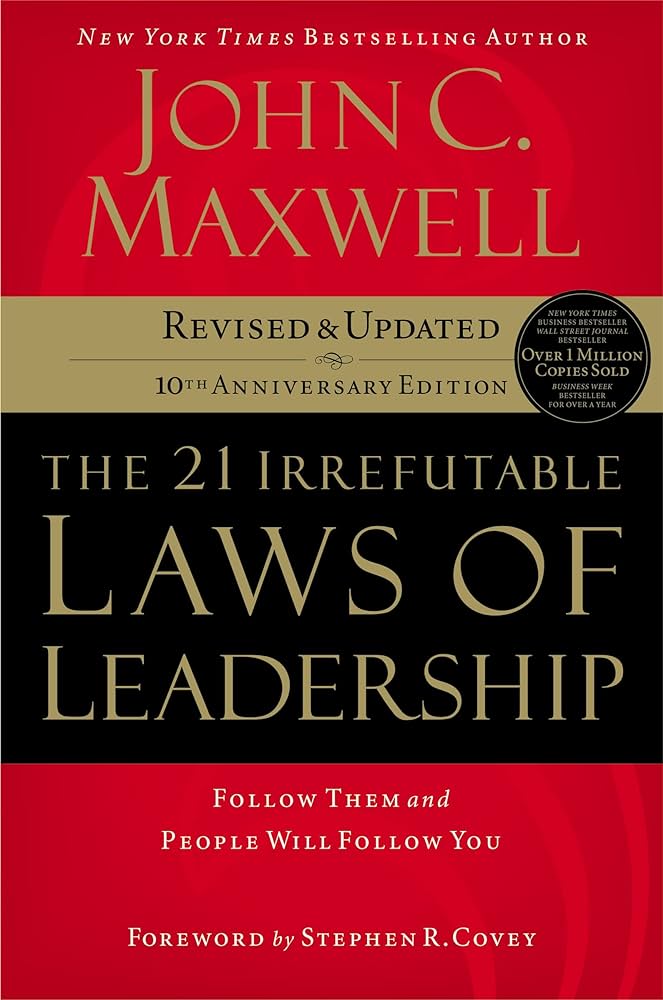
📖 Book Recommendation: The 21 Irrefutable Laws of Leadership by John C. Maxwell 📖
While I love each of Maxwell’s 21 Laws, the Law of the Lid is likely my favorite. It was the first time I really saw the relevance that my leadership was either a multiplier or a governor on the effectiveness of my team. The Law of the Lid states that a person’s leadership ability determines the level of effectiveness of the entire team. Thus, the higher a person’s leadership skills, the greater their potential for success for every person on the team and the team as a unit. If a person’s leadership ability is limited, their potential for achievement is also capped. To increase a team member’s success, it’s crucial to develop one’s own leadership abilities, as they directly impact how far a person or team can go. Get the book here or take a listen here.
.

Leave a comment