In 1980, researchers at Dartmouth College conducted a fascinating psychological experiment*. Women were invited to participate in what they believed was a study on physical appearance and job interviews. Using professional makeup artists, the researchers applied realistic scars to the women’s faces. The women were then told they would be interviewed and evaluated.
Right before each interview, the researchers said they needed to “touch up” the scar. In reality, they removed it entirely.
The women walked into those interviews with completely clear faces.
But when they came out? Many reported feeling judged. They described perceived discrimination, bias, subtle comments, and reactions they believed were related to the scar.
The scar that wasn’t there.
That study has stayed with me because it raises a powerful question:
Where are we walking into rooms carrying scars that no one else can see?
The Invisible Scar We Carry
Maybe it’s a failure from five years ago.
Maybe it’s weight you gained.
Maybe it’s a divorce.
Maybe it’s your age.
Maybe it’s your race or your religion.
Maybe it’s the time you were fired.
Maybe it’s a deal that blew up.
We convince ourselves that everyone sees it. That it defines us. That it precedes us.
And so we scan the room for evidence.
A neutral expression becomes judgment.
A short answer becomes dismissal.
A missed callback becomes proof.
But what if the bias we’re feeling isn’t coming from them?
What if it’s coming from us?
Now let me be clear: real bias exists. Real discrimination exists. I am not minimizing that reality. Systems and people can absolutely behave unfairly. I’ve been in the workforce long enough to see it.
But I’ve also seen something else.
As a woman in sales—an industry that is often highly merit-based—I’ve personally never felt like someone was taking my spot because of my gender. In fact, I’ve sometimes opted out of women-only professional groups because I didn’t resonate with an underlying narrative that “we must stick together or the men will take our seats.”
That wasn’t my experience.
Again, I’m not claiming that experience is universal. I’ve been fortunate. But I do think it’s worth asking: Are we sometimes reinforcing the very scarcity or bias we fear?
Are we amplifying a scar that no one else is focusing on?
Self-Perception Is a Powerful Filter
Human beings are pattern-seeking machines. If we believe we’re walking around with a flaw, we subconsciously look for confirmation.
That’s how the Dartmouth study worked.
The participants believed they had a scar. So they interpreted neutral behavior through that lens.
And we do the same thing every day.
If you believe:
- “I’m too old.”
- “I’m too inexperienced.”
- “I’m not polished enough.”
- “I’m not as smart as they are.”
- “I’m behind.”
- “I don’t belong here.”
You will filter everything through that assumption.
And here’s the dangerous part: your behavior will subtly shift.
You’ll:
- Speak more hesitantly.
- Over-explain.
- Avoid eye contact.
- Downplay your ideas.
- Apologize for taking up space.
And then when someone responds with less enthusiasm than you hoped, you’ll attribute it to the “scar.”
But what if the scar isn’t there?
Or what if it exists only in the weight you’ve assigned to it?
The Agreements We Make With Ourselves
In the book The Four Agreements, Don Miguel Ruiz outlines four principles for personal freedom. Two are especially relevant here:
- Don’t take anything personally.
- Be impeccable with your word.
We often think “being impeccable with your word” means how we speak to others.
But what about how we speak to ourselves?
What words are you using internally?
Are you declaring:
- “This is my weakness.”
- “This always happens to me.”
- “People like me don’t get ahead.”
- “They won’t take me seriously.”
If you say it often enough, you’ll start living it.
Your internal narrative becomes the makeup artist. It paints on a scar.
And then you go looking for proof.
Wiping the Scar Off
The women in that experiment unknowingly walked into the room without the scar. Yet they behaved as if it was still there.
The real power shift happens when we consciously wipe ours off.
That doesn’t mean pretending real obstacles don’t exist.
It means asking:
- Is this barrier factual, or is it interpretive?
- Is this feedback real, or am I assuming?
- Is this a pattern in the world, or a pattern in my perception?
- Am I showing up as someone who believes they belong?
Here’s the deeper question:
Who am I being when I enter the room?
If I walk in thinking, “They’re going to judge me,” my posture changes.
If I walk in thinking, “I have less value to bring,” my presence changes.
If I walk in thinking, “I’m already behind,” my energy shifts.
But if I walk in thinking, “I belong here, and I’m here to contribute,” something powerful happens: the scar loses its grip.
Are You Showing Up Scarred or Strong?
We all have real stories. Real failures. Real disappointments.
But a story is not a sentence.
A failure is not a permanent mark.
An insecurity is not an identity.
So before your next meeting, pitch, interview, or hard conversation, pause and ask:
- What scar am I assuming I’m wearing?
- Is it visible to others—or only to me?
- What would change if I walked in without it?
You don’t need to pretend your past didn’t happen. You just need to decide whether it defines your entrance.
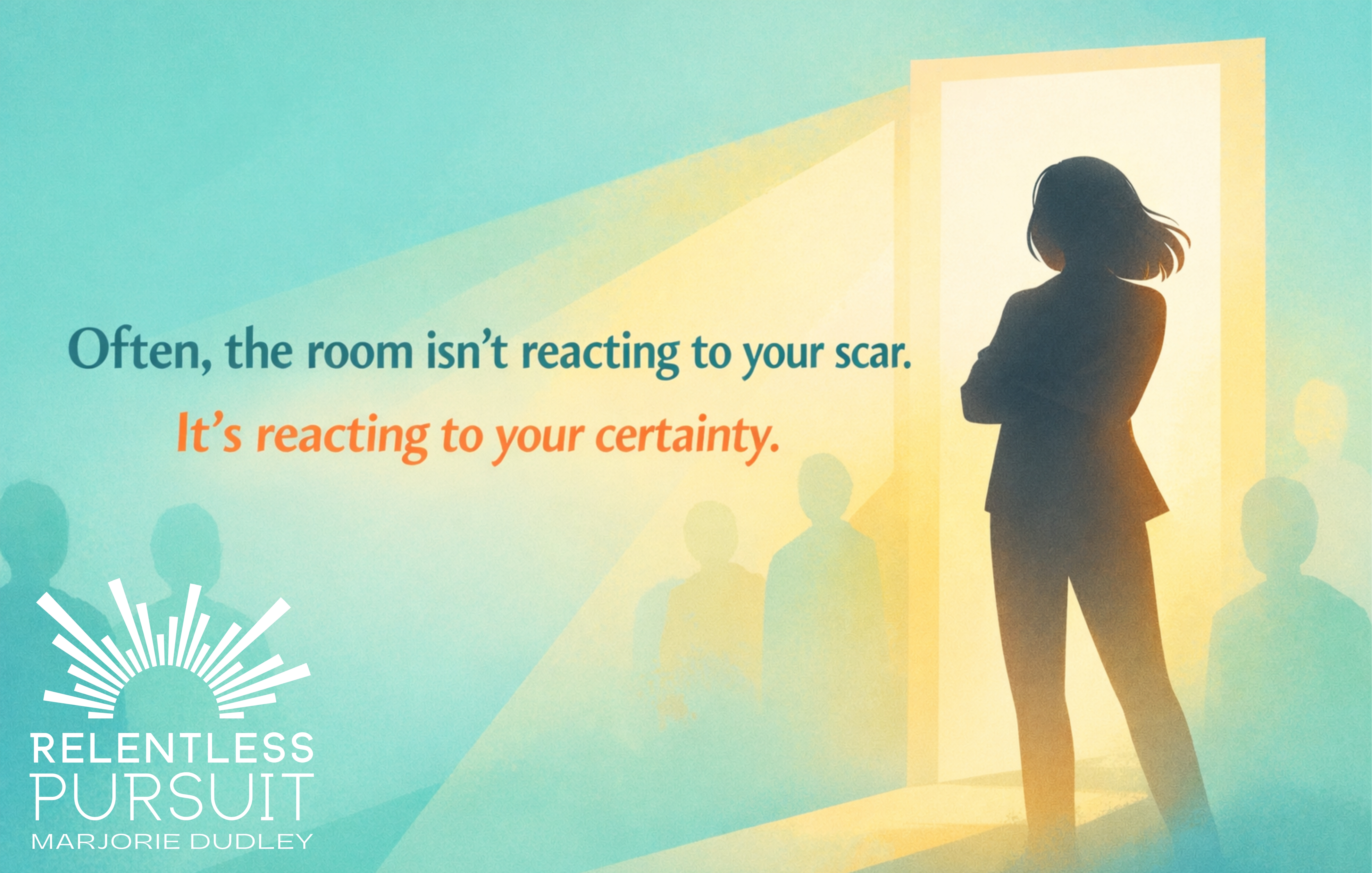
Because often, the room isn’t reacting to your scar. It’s reacting to your certainty.
And certainty doesn’t come from perfection. It comes from wiping off what you imagined was disqualifying in the first place.
The most powerful shift you can make isn’t demanding the world treat you differently.
It’s deciding to show up as someone who no longer believes the scar is there.
Stay Relentless.
*https://www.psychologytoday.com/us/blog/beyond-school-walls/202410/invisible-scars

Leave a comment